
South Florida sun is bright, hot, and nearly year-round. So when homeowners ask us which window shades to choose, the answer usually comes down to two options: solar shades and blackout shades. Both are types of roller shades, and both are popular in Miami-Dade, Broward, and Palm Beach homes. However, they solve very different problems.
Quick answer: when weighing solar shades vs. blackout shades, choose solar shades when you want to cut glare and heat but keep your view. Choose blackout shades when you need a dark room for sleeping or watching TV. For many rooms, the best answer is both, mounted together as a dual shade.
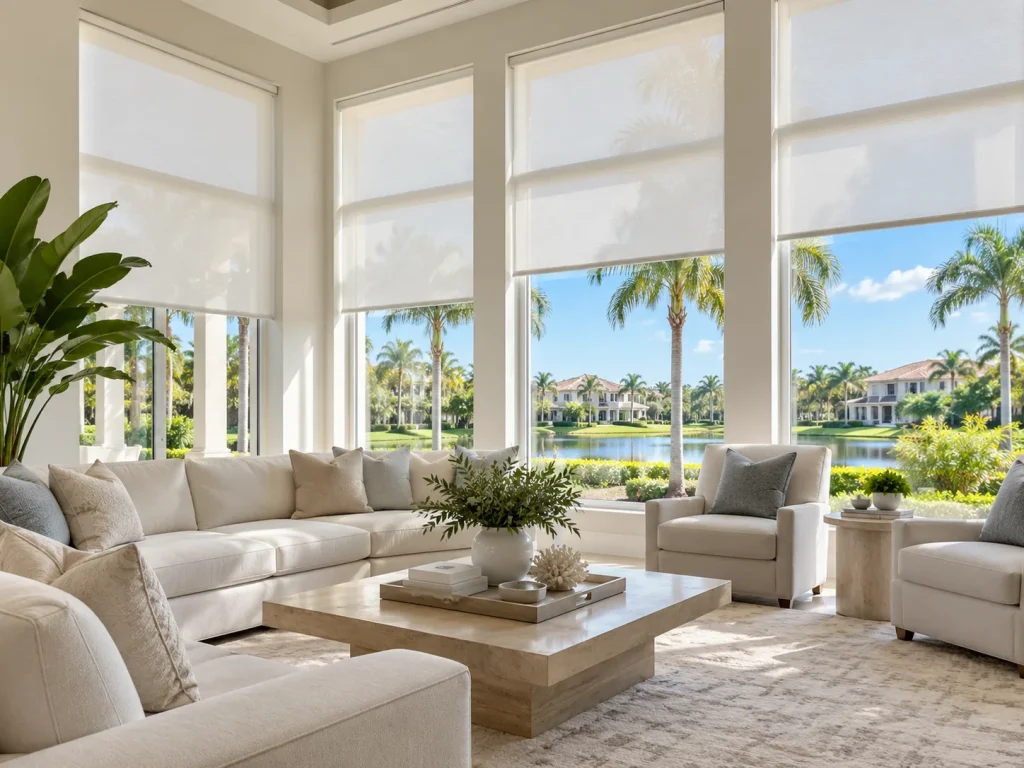
What Are Solar Shades?
Solar shades are made from a woven screen fabric with tiny openings. As a result, they block a large share of the sun’s glare and UV rays while you still see outside. During the day, you can look through them to your pool, lake, or skyline view, but people outside have a harder time seeing in.
Solar fabrics are rated by openness, the percentage of the fabric that is open weave. Lower openness, such as 1% or 3%, blocks more glare and gives more daytime privacy. Higher openness, such as 5% or 10%, keeps a clearer view and lets in more light. For more background, the U.S. Department of Energy has a helpful overview of energy-efficient window attachments.
Where solar shades work best
- Living rooms and family rooms with a view you want to keep
- Condos with floor-to-ceiling glass facing the ocean, bay, or Intracoastal
- West-facing rooms that heat up in the afternoon
- Home offices where screen glare is a problem
What Are Blackout Shades?
Blackout shades use a solid, opaque fabric, often with a vinyl or acrylic backing, that blocks nearly all light. When lowered, they give you full privacy day and night and make a room dark enough to sleep in, even with Florida’s early sunrises.
Keep in mind that some light can still slip around the edges of any roller shade. If you need a truly dark room, ask about side channels or an outside mount that overlaps the window frame.
Where blackout shades work best
- Bedrooms and nurseries
- Media rooms and home theaters
- Rooms for shift workers who sleep during the day
- Any room that needs full nighttime privacy
Solar vs. Blackout Shades: Side-by-Side Comparison
| Feature | Solar shades | Blackout shades |
|---|---|---|
| Light control | Filters light and cuts glare | Blocks nearly all light |
| View outside | Yes, during the day | No, when lowered |
| Daytime privacy | Good, depending on openness | Complete |
| Nighttime privacy | Limited when lights are on inside | Complete |
| UV protection for floors and furniture | High | Very high |
| Heat control | Reduces solar heat | Reduces solar heat, especially with a reflective backing |
| Best rooms | Living areas, offices, condos with views | Bedrooms, nurseries, media rooms |
The Nighttime Privacy Catch With Solar Shades
This is the most common surprise we hear about. Solar shades give good daytime privacy because it is brighter outside than inside. At night, that flips. With your lights on, people outside can see in through a solar shade. Therefore, if a room faces the street or a neighboring building, plan for a second layer for evenings. After dark is where the solar shades vs. blackout shades difference matters most.
The Best of Both: Dual Roller Shades
A dual roller shade mounts a solar shade and a blackout shade on one bracket. You lower the solar shade during the day to manage glare, then lower the blackout shade at night for privacy or sleep. It is a popular choice for South Florida bedrooms that face the water or get strong morning sun.
Dual shades also pair well with motorization. With a remote or app, you can schedule the solar shade to lower during the hottest part of the day and the blackout shade to close at bedtime.
South Florida Tips for Choosing Shades
- Check your condo or HOA rules. Many buildings require a white or neutral color facing outside. Solar and blackout fabrics both come with light-colored backings that usually comply.
- Think about direction. East-facing bedrooms get early sun, so blackout matters. West-facing living areas get afternoon heat, so solar shades help most.
- Choose moisture-friendly fabrics. In bathrooms and kitchens, vinyl-backed or easy-clean fabrics hold up better to humidity.
- Measure for sliders. On sliding glass doors, make sure shades clear the door handles, or consider drapery on a track instead.
- See samples in your own light. A fabric can look very different at your window than in a showroom photo.
Frequently Asked Questions
Do solar shades block heat?
Yes. Solar shades reduce the amount of solar heat that enters through the glass, which helps keep rooms cooler. Darker solar fabrics usually cut more glare, while lighter fabrics reflect more heat.
Can people see through solar shades at night?
Yes, when your lights are on inside. Solar shades provide daytime privacy, but at night you need a blackout shade, drapery, or another layer for privacy.
Are blackout shades good for South Florida bedrooms?
Yes. They block early morning sun and outdoor light, which helps with sleep. For the darkest result, ask about side channels or an outside mount.
Can I get solar and blackout shades on the same window?
Yes. A dual roller shade holds both on one bracket, so you can switch between glare control by day and full privacy at night.
Which shade is better for a condo with an ocean view?
Solar shades are usually the first choice because they cut glare and UV while keeping the view. Many condo owners add blackout shades in bedrooms or choose dual shades.
Get Help Choosing the Right Shade
Not sure which option fits each room? We bring solar and blackout samples to your home, check them against your actual light, and measure every window. Request a free in-home estimate, or see our roller shades page for more options. We serve homes across Miami-Dade, Broward, and Palm Beach counties.